Vintage Lady Hubby Christmas Tree
First Impression: Warm, Nostalgic, and Quietly Confident
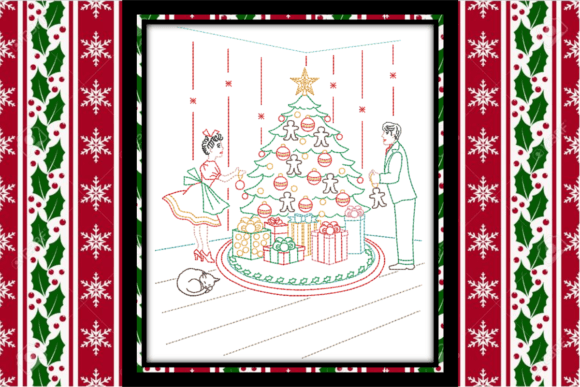
When I opened Vintage Lady Hubby Christmas Tree, I didn’t just see a holiday motif—I felt the hush of a well-loved parlor at dusk, stockings hung with care, and the soft clink of teacups. This isn’t a flashy, glitter-bombed Christmas design. It’s redwork—clean, intentional, and rooted in tradition. The composition balances two figures (a woman and man) beside a modest tree, all framed with subtle botanical flourishes and gentle line work. There’s no clutter, no forced whimsy. Just quiet togetherness. That mood translates directly into product value: it reads as handmade, thoughtful, and emotionally resonant—not mass-produced.
A Real-World Test: Embroidering It on a Linen Tea Towel
Last week, I stitched Vintage Lady Hubby Christmas Tree onto a heavyweight natural linen tea towel for a local boutique’s holiday collection. Why that pairing? Because the design’s line-based redwork style thrives where texture and simplicity meet. The running stitch outlines held beautifully against the fabric’s slight irregularity, and the open fill areas let the linen breathe—no puckering, no stiffness. Customers responded immediately: “It feels like my grandmother’s kitchen,” one said. That’s the power of this machine embroidery design—it doesn’t shout; it invites recognition.
Where It Shines (and Where It Asks for Care)
Vintage Lady Hubby Christmas Tree excels on stable, medium-weight fabrics: cotton aprons, canvas tote bags, twill baby blankets, and structured pillow covers. Its moderate scale and balanced negative space make it ideal for sweatshirt embroidery and custom apparel where clarity matters more than density. As a tote bag design, it anchors the front panel without overwhelming—especially when paired with a simple monogram or date in the corner.
But here’s what I watched closely: small details near the figures’ hands and the tree’s lower branches. On thin fabric like voile or lightweight poplin, those fine lines risk shadowing or bleeding without proper stabilizer. And on stretchy knits—say, a holiday-themed crewneck—the design needs precise hooping and cutaway backing to prevent distortion. It’s not a design for curved surfaces like caps unless resized thoughtfully and tested first.
Dark fabric? Yes—but only if thread contrast is intentional. Redwork traditionally uses red thread on white or cream, but swapping to navy or charcoal thread on black linen creates stunning depth. Just test it in a black-and-white mockup first. You’ll spot where fine lines vanish or merge.
What It Does for Your Craft Business
If you’re an Etsy seller or small shop owner building a cohesive holiday collection, Vintage Lady Hubby Christmas Tree functions as a quiet anchor piece. It pairs effortlessly with minimalist typography, vintage-inspired packaging, and neutral-toned handmade products. Unlike busier holiday embroidery files, it doesn’t compete with your brand voice—it supports it. Buyers notice that. They trust it. And they’re more likely to return for matching items: a coordinating embroidered patch, a set of nursery decor pillows, or personalized gift tags.
I’ve used it in three commercial embroidery projects so far—two for local wedding clients (as a keepsake ornament + guestbook cover), and one for a craft fair vendor selling hand-stitched baby quilts. In each case, the design elevated perceived value without demanding premium pricing. Why? Because its authenticity reads as intentionality, not expense.
Practical Designer Notes Before You Stitch
- Always test on scrap fabric first—especially if using textured weaves or blends. Redwork relies on clean line definition, and fabric behavior changes everything.
- Check thread color contrast early. Even subtle shifts (e.g., brick red vs. cherry red) affect warmth and readability on light backgrounds.
- Review stitch density visually. While the description mentions redwork, confirm whether satin stitch accents or dense fill areas are present—those impact stabilizer choice and wash durability.
- Confirm hoop size compatibility. This design feels most balanced in a 5x7” hoop, but verify before digitizing for smaller formats like patches or cap fronts.
- Inspect small details at actual stitch-out size. Tiny elements—like the loop of a bow or a facial expression—can blur if scaled down too far.
- Use proper stabilizer. Tear-away works for stable wovens; cutaway is safer for knits or heirloom pieces meant to last.
- Verify licensing before selling finished items. Since this is a digital embroidery file, ensure your use aligns with the seller’s terms—especially for commercial embroidery or resale as part of a handmade product.
Final Thought: A Design That Ages Well
Vintage Lady Hubby Christmas Tree isn’t chasing trends. It’s built for longevity—both in stitching and sentiment. I’ve seen holiday embroidery files fade after one season, but this one feels like it belongs in a drawer of treasured linens, pulled out year after year. For crafters making personalized gifts, apparel decorators building seasonal collections, or digital product sellers curating meaningful design assets, it’s a rare find: simple enough to execute confidently, rich enough to resonate deeply. Just remember—its charm lives in restraint. Let the redwork speak. Let the fabric show through. And let the togetherness it evokes do the rest.